
Why UK eCommerce Businesses Are Looking Beyond Stripe in 2026
For many UK eCommerce businesses, Stripe was the obvious choice in the earlystages. It’s developer-friendly, easy to implement, and fast to launch.
But as businesses scale, payment infrastructure stops being a background tool andstarts becoming an operational cost centre. Fees become more noticeable, supportdelays become more expensive, and reconciliation becomes more complex.
That’s why more UK merchants are beginning to reassess Stripe in 2026 — becausetheir business has evolved beyond what a self-serve platform is designed tooptimise for.
But as businesses scale, payment infrastructure stops being a background tool andstarts becoming an operational cost centre. Fees become more noticeable, supportdelays become more expensive, and reconciliation becomes more complex.
That’s why more UK merchants are beginning to reassess Stripe in 2026 — becausetheir business has evolved beyond what a self-serve platform is designed tooptimise for.
Stripe Works Well — Until Scale Changes the Equation
Stripe earned its position in the market for good reason. Its APIs are strong,onboarding is straightforward, and businesses can start accepting payments quicklywithout lengthy underwriting processes or complicated contracts.
For early-stage businesses, that level of ease is invaluable. For businessesprocessing significant monthly volume, the conversation is increasingly shifting from“How quickly can we launch?” to “What is our payment setup actually costing us?”.
The challenge is that the same pricing and support model that works well at lowervolumes can become increasingly expensive as transaction volume grows.At scale, merchants begin paying closer attention to:
For early-stage businesses, that level of ease is invaluable. For businessesprocessing significant monthly volume, the conversation is increasingly shifting from“How quickly can we launch?” to “What is our payment setup actually costing us?”.
The challenge is that the same pricing and support model that works well at lowervolumes can become increasingly expensive as transaction volume grows.At scale, merchants begin paying closer attention to:
- Processing costs
- Invoice creation fees
- Radar fees
- Invoicing tax calculation
- Per-month connected account fees
- Instant payout fees
- Operational support responsiveness
This is typically the point where finance teams, operations leads, and founders startreviewing their payment infrastructure more critically.
The issue is rarely a single breaking point. In most cases, it’s the accumulation ofsmall inefficiencies that becomes difficult to ignore over time.
The issue is rarely a single breaking point. In most cases, it’s the accumulation ofsmall inefficiencies that becomes difficult to ignore over time.
Why UK Merchants Start Reassessing Stripe
One of the biggest drivers is visibility into actual payment processing costs.
Stripe’s pricing appears simple (initially), but many businesses eventually realise theadvertised rate is only part of the picture. Once scheme fees, FX fees, radar fees, andadditional platform products are included, the effective processing rate can lookvery different from the headline pricing.
Stripe’s pricing appears simple (initially), but many businesses eventually realise theadvertised rate is only part of the picture. Once scheme fees, FX fees, radar fees, andadditional platform products are included, the effective processing rate can lookvery different from the headline pricing.
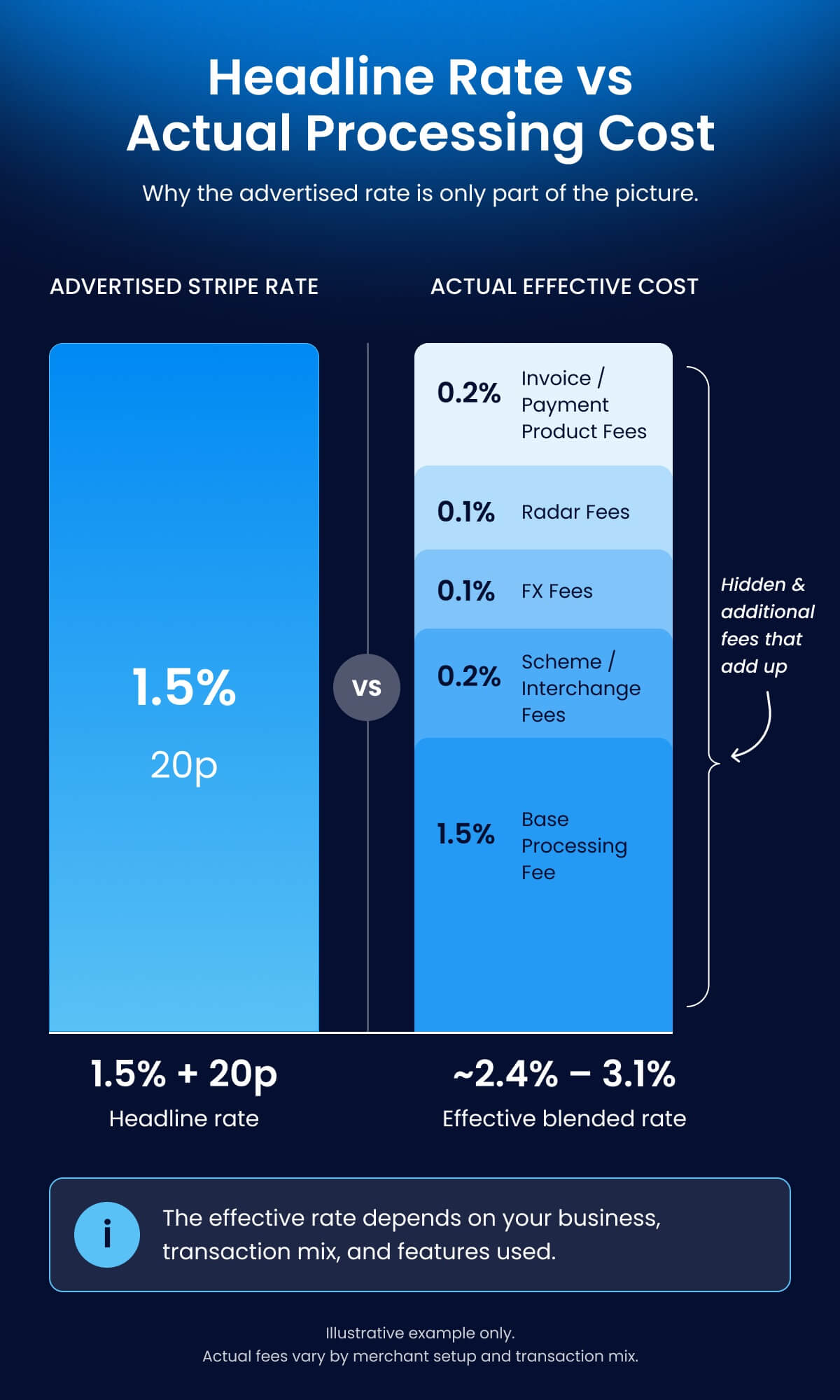
For eCommerce businesses operating on increasingly tight margins, even modestpercentage differences in payment costs can materially impact profitability.
Support is another major factor.
Stripe’s self-service operating model works efficiently most of the time, untilsomething time-sensitive happens. A payment issue during a high-volume salesperiod, an account review, or a dispute escalation becomes significantly morestressful when support is limited to tickets and delayed responses.
For UK merchants, there’s also the question of operational fit.
Many businesses want:
Support is another major factor.
Stripe’s self-service operating model works efficiently most of the time, untilsomething time-sensitive happens. A payment issue during a high-volume salesperiod, an account review, or a dispute escalation becomes significantly morestressful when support is limited to tickets and delayed responses.
For UK merchants, there’s also the question of operational fit.
Many businesses want:
- UK-focused payment expertise
- Faster access to human support
- Local acquiring relationships
- More hands-on onboarding
- Guidance during migration and scaling
Stripe’s platform is built for global standardisation rather than region-specific service.
As businesses mature, many begin looking for providers that operate more likestrategic payment partners than purely software platforms.
As businesses mature, many begin looking for providers that operate more likestrategic payment partners than purely software platforms.
The Real Cost of Payment Infrastructure at Scale
Many businesses focus too heavily on headline transaction rates.
A proper comparison should account for:
A proper comparison should account for:
- Gateway fees
- Authorisation performance
- Failed payment rates
- FX and cross-border fees
- Radar fees
- Chargeback handling costs
- Downtime risk
- Operational overhead
- Support responsiveness
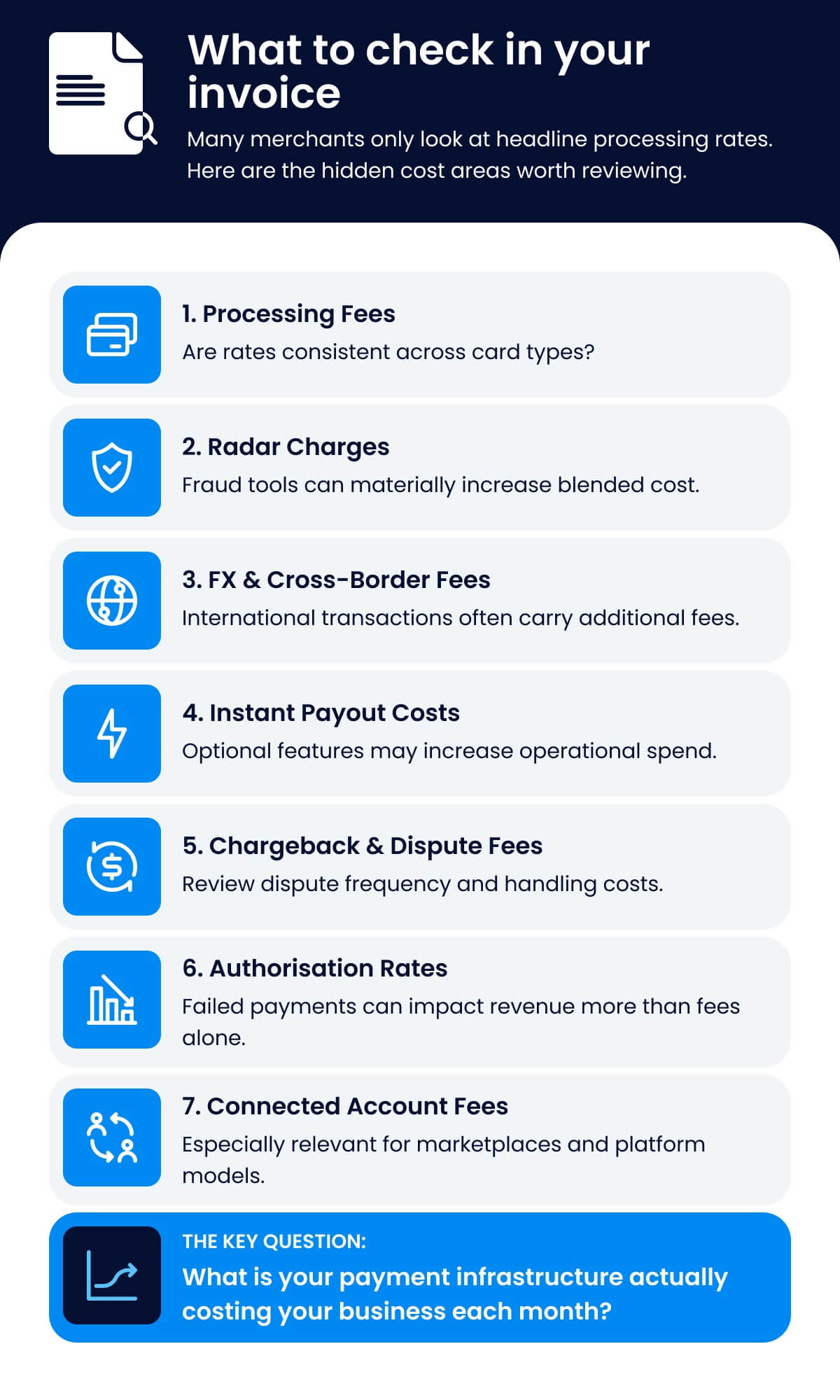
For example, a provider with slightly lower fees but poor authorisation rates mayultimately cost more in lost revenue.
Many larger eCommerce businesses now evaluate providers through an operationallens, not just a pricing lens.
They want:
Many larger eCommerce businesses now evaluate providers through an operationallens, not just a pricing lens.
They want:
- Predictable costs
- Reliable support
- Stable acquiring relationships
- Better visibility into transaction performance
- Infrastructure that scales with business complexity
That shift in mindset is driving increased interest in Stripe alternatives across the UKeCommerce market.
What Businesses Actually Want From a Stripe Alternative
Most merchants are not looking for the cheapest possible payment provider.
They are looking for a provider that reduces operational friction while improvingcommercial outcomes.
In practice, that usually means:
They are looking for a provider that reduces operational friction while improvingcommercial outcomes.
In practice, that usually means:
- More transparent pricing structures
- Faster support response times
- Easier reconciliation processes
- Better onboarding support
- Stronger migration assistance
- Payment infrastructure designed for scaling businesses
Migration support has become particularly important.
Many businesses delay switching providers because they assume migration willinvolve major downtime, checkout disruption, or significant development work.
Modern payment migrations are often more manageable than expected, especiallywith onboarding and token migration support. For businesses using platforms likeWooCommerce, implementation can often be completed quickly using existingintegrations rather than full custom rebuilds.
Many businesses delay switching providers because they assume migration willinvolve major downtime, checkout disruption, or significant development work.
Modern payment migrations are often more manageable than expected, especiallywith onboarding and token migration support. For businesses using platforms likeWooCommerce, implementation can often be completed quickly using existingintegrations rather than full custom rebuilds.
Why Migration Is Usually Less Disruptive Than Expected
Fear of disruption is one of the biggest reasons businesses stay with paymentproviders longer than they should.
There’s a perception that switching means:
There’s a perception that switching means:
- Rebuilding the checkout experience
- Losing saved payment methods
- Introducing downtime
- Retraining teams
- Creating risk during peak trading periods
But for many eCommerce businesses, the migration process is actually morestraightforward when managed properly.
Modern payment providers increasingly offer:
Modern payment providers increasingly offer:
- API migration assistance
- Token migration support
- Onboarding specialists
- Staged rollout processes
- Developer documentation
- Platform-specific integrations
The result is that businesses can often transition payment infrastructure withoutmaterially affecting the customer experience.
That operational support becomes especially valuable for merchants processinghigher transaction volumes where downtime risk carries real financial implications.
That operational support becomes especially valuable for merchants processinghigher transaction volumes where downtime risk carries real financial implications.
Where Synapto Fits for UK eCommerce Businesses
Synapto positions itself specifically around the challenges many scaling UKeCommerce businesses experience with larger self-service payment platforms.
The platform focuses on reducing payment processing costs while offering morehands-on operational support.
For businesses evaluating alternatives to Stripe, the appeal typically comes down toa few areas:
The platform focuses on reducing payment processing costs while offering morehands-on operational support.
For businesses evaluating alternatives to Stripe, the appeal typically comes down toa few areas:
- UK-focused support and onboarding
- Dedicated account management
- Transparent pricing structures
- Faster response times
- Simplified migration support
- Compatibility with existing eCommerce setups
The platform also supports merchants looking to avoid major checkout disruptionduring migration. Businesses can maintain their existing checkout experience while transitioning payment infrastructure behind the scenes.
For WooCommerce businesses specifically, the existing integration ecosystem cansimplify onboarding further.
Book a call with Synapto to see how it could work for your business.
For WooCommerce businesses specifically, the existing integration ecosystem cansimplify onboarding further.
Book a call with Synapto to see how it could work for your business.
The Decision Most Businesses Are Actually Making
For most merchants, the decision is not about whether Stripe works. It’s aboutwhether the business has reached a stage where payment infrastructure needs todeliver more than convenience.
If you’re currently reviewing your payment infrastructure, the first step isunderstanding what your existing setup is actually costing you across fees,operational overhead, and support limitations.
You can learn more about Synapto’s UK eCommerce payment platform or book a demo with the team to compare your current payment costs and migration options.
If you’re currently reviewing your payment infrastructure, the first step isunderstanding what your existing setup is actually costing you across fees,operational overhead, and support limitations.
You can learn more about Synapto’s UK eCommerce payment platform or book a demo with the team to compare your current payment costs and migration options.
